

By Sophia Auer, Contributing Writer
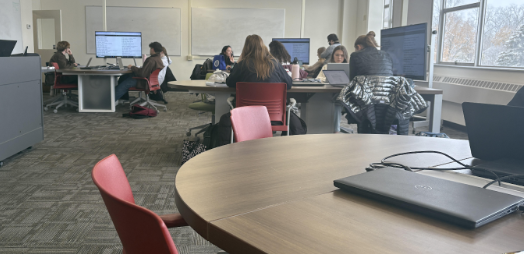
Students participate in a 9 a.m. class in Duns Scotus Hall at Daemen University, working together on assignments as morning sunlight fills the room.
College classes that begin early in the morning may be doing more harm than good to students’ learning, sleep and attendance, according to research and firsthand accounts from Daemen University students and professors.
At Daemen, physical therapy major, Brianna Caliri said her earliest class begins at eight a.m. While it takes some adjustment, she sees benefits in this schedule.
“It gets me up early for the day, and I’m done with it earlier than later classes,” Caliri said. “In the later classes, I’m normally more tired, and I feel a little less wanting to participate. For me personally, I think they help me.”
But not all students feel the same way. Jesse Hamann, a senior English major at Daemen, said early mornings make learning more difficult for her. Hamann has two early classes this semester, but her schedule still requires her to be on campus early every day.
‘I’m not a morning person, so I don’t like them,” Hamann said. “But sometimes you can’t control when you get into a class… I would rather be doing work later than, like, 8 in the morning or 9 in the morning. I have a four-to-seven class this semester, and I’m definitely more engaged in that one as opposed to the early ones.”
A growing body of research supports Hamann’s findings and suggests that early college class times can negatively affect students’ sleep and performance. A 2023 study published in “Nature Human Behaviour” found students with first classes at eight a.m. had attendance rates about 10 percentage points lower than those whose first class began at 10 a.m. or later. The same study found that earlier class times were linked to shorter sleep duration, greater “social jet lag” (the difference between weekday and weekend sleep schedules), and slightly lower grades on average.
Elizabeth Falzone, an assistant professor in Daemen’s education department, said class timing can play a major role in how both students and professors engage in the learning process.
“My response to this question is somewhat unique because it aligns with my preferred teaching style,” Falzone said. “I typically embed experiential learning opportunities into my courses. With this approach, afternoon and evening classes are most convenient because they allow my students to apply their knowledge in real-world settings.”
Falzone added she regularly adjusts her teaching methods to accommodate students’ energy levels and engagement throughout the day.
“I have to be intentional and strategic in my planning in order to create learning experiences that foster deep critical thinking, meaningful discussion and reflection,” she said. “I want students to be active participants in the learning process, so ensuring sustained engagement, regardless of class length or scheduling structure, is essential.”
She added that class timing affects each instructor differently.
“Each professor will have their own unique teaching style,” Falzone said. “For me, I strive to create learning experiences where students construct their own understanding of content through active participation and engagement.”
As universities continue to study the connection between start times, sleep and academic performance, the debate remains far from settled. For students like Caliri, early classes mean productivity and free afternoons. But for others like Hamann, research suggests a few extra hours of sleep could make a real difference in how well college students learn and thrive.