

By Peyton Johns, Sports Editor and Zorian Edwards, Editor-in-Chief
When it comes time to register for classes, most students know that they need Depth Discovery, but not everyone knows what that actually means. Despite having different majors, all students are required to complete these courses during their time at Daemen, leaving many unsure of how they work or why they matter.
“I kind of understand them. The form for Depth Discovery requires you to put all three classes down, I feel we should simplify the paperwork for it,” Carrie Schmeelk, sophomore graphic design major, said. “This way, it could be one slip of paper per class. People change their interests.”
Depth Discovery acts as a general education requirement alongside Breadth Exploration of Liberal Arts (18 credits) and the First-Year Experience program (9 credits). Altogether, these requirements total 36 credits and are designed to prepare students for their academic and professional careers.
Breadth Exploration courses are courses that fall within natural sciences, social studies and the humanities. Students are required to take two courses (6 credits) within each category.
Each student completes their First-Year Experience program during their freshman year through the Gearing-Up program. This course teaches students the basics of college life, such as budgeting and time management.
Depth Discovery is typically the last portion of the general education requirements that students have to take.
According to Daemen’s website, “Students take three courses that focus on a specific topic. They can fulfill this requirement through an approved depth discovery topic, an approved interdisciplinary minor, or studying abroad.”
While that definition explains the requirement, it doesn’t always make the process clear for students.
Students can choose from different categories within Depth Discovery and declare their category after two classes. The topics of these classes can range from writing instructive courses to forensic and criminal justice classes.
“It’s a focused series of classes that allow you to explore a topic in greater depth,” Noah Herman, visiting assistant professor of graphic design, said. “It’s different from the Breadth classes that allow you to explore a greater variety of classes.”
Breadth Exploration of Liberal Arts focuses on giving students a wider range of coursework across disciplines.
“Students take two courses (6 credits each) in three different areas, including natural science and mathematics; social science; and the humanities,” Daemen’s website states.
Shawn Kelly, professor and general education program director, said the program aims to bring three interrelated classes together around a specific theme from different perspectives.
“They (students) take a course that fits in this larger set of questions, then say, ‘okay, this is the one I want to do,’” Kelly said. “Then once the first course is declared, we can move it over to the discovery part.”
Students can choose a Depth Discovery category before starting, but they may not end up liking it. It’s recommended that students declare after or while they’re taking the second course.
Categories include Bodies, Mind and Health; Art and Human Expression; Power, Conflicts and Politics; Making Sense of the News; and others.
These categories are groups of classes that flow into each other for depth discovery. For example, classes that fall into Art and Human Expression are geared towards art and literary courses.
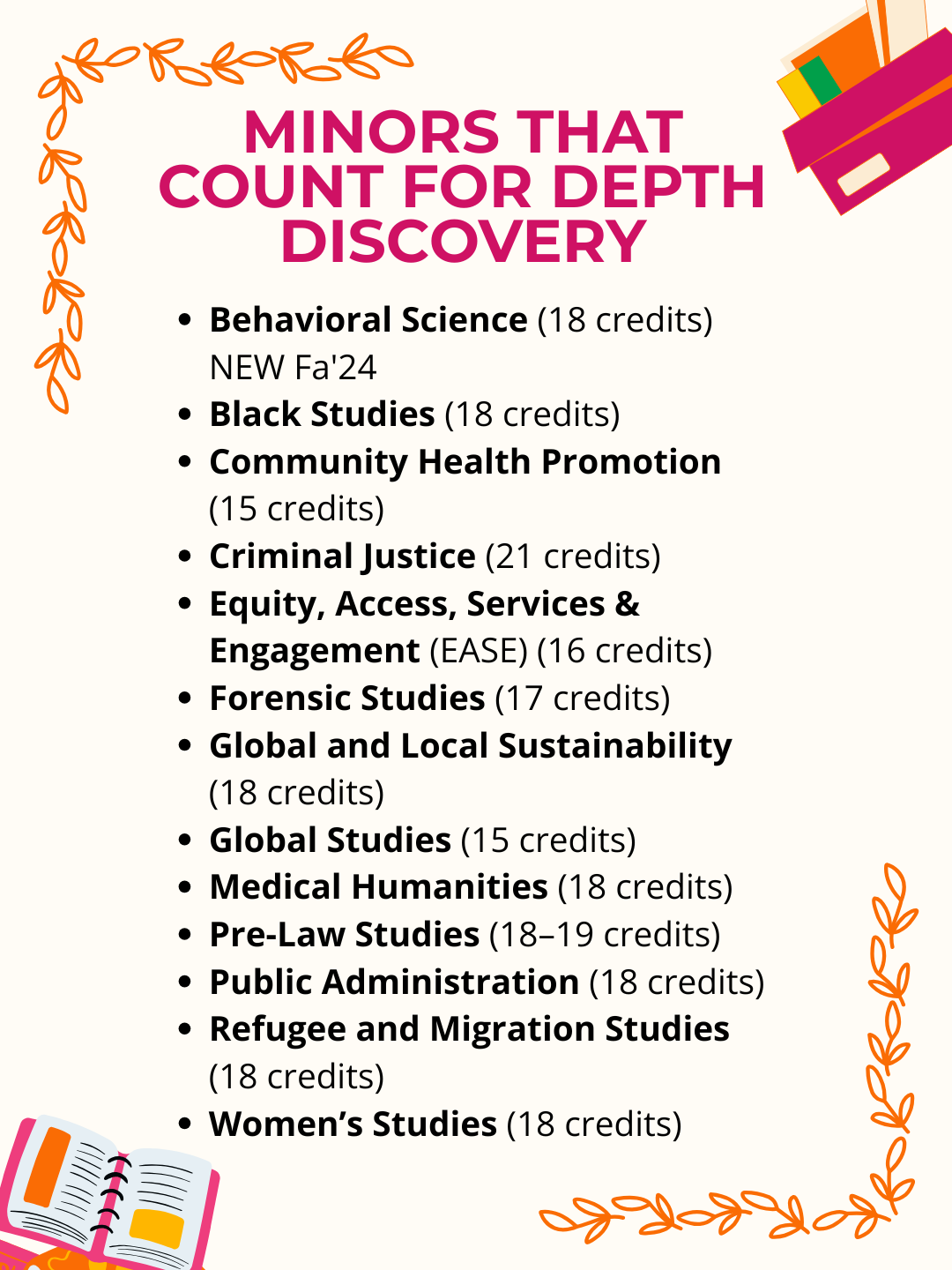
Additionally, some interdisciplinary minors can count toward the same requirement.
“In a way, compared to a minor, the depth is sort of like a mini minor,” Hella Jacob, director of the center for excellence in teaching and learning, said. “It’s about half a minor. A minor could probably be around six courses, typically around 18 credit hours, some are 20 credit hours.”
Kelly noted that if students are interested in learning more about Depth Discovery and the different paths to explore, they should book an appointment with him to discuss further. He prefers to be contacted by email at skelley@daemen.edu.